PLAY TRAILER

0:00/1:34

The Grounds for Concern Podcast

The Grounds for
Concern Podcast

OVERVIEW

Grounds for Concern is a seven-episode podcast and public exhibition exploring how perspectives from neuroscience, law, education, and beyond can help emerging designers think more critically about AI.

Somewhere between “AI is inevitable” and “AI is dangerous,” there has to be room for a conversation.

Duration

Mar–Jun 2026

Team

Lia Chon

MY ROLE

Podcast Hosting, Qualitative Research, Exhibition Experience Design, Audio Editing

“I worry that the cons of AI are going to far outweigh the pros. Obviously it's inevitable, but I just think it's terrible.”

“I worry that the cons of AI are going to far outweigh the pros. Obviously it's inevitable, but I just think it's terrible.”

“I worry that the cons of AI are going to
far outweigh the pros. Obviously it's inevitable, but I just think it's terrible.”

sophomore in industrial design

“AI is inevitable. It makes more sense to learn how to use it and stay competitive than to resist it and fall behind.”

“AI is inevitable. It makes more sense to learn how to use it and stay competitive than to resist it and fall behind.”

“AI is inevitable. It makes more sense
to learn how to use it and stay competitive than to resist it and fall behind.”

SENIOR IN INTERACTION DESIGN
THE CHALLENGE

Design students are at a crossroads…

Design students are at a crossroads…

We kept hearing two opposing messages: learn to use AI or resist it. But neither perspective gave us much room to ask why, when, or how AI should actually fit into design practice.

We kept hearing two opposing messages: learn to use AI or resist it. But neither perspective gave us much room to ask why, when, or how AI should actually fit into design practice.

More importantly, we realized that students didn't have many places to have those conversations. An uninformed designer is a danger to themselves and the world around them.

We decided to carve out our own space.

How can interdisciplinary learning influence new designers' desire to design with intention when using AI?

How can interdisciplinary learning influence new designers' desire to design with intention when using AI?

CENTRAL RESEARCH QUESTION
PRELIMINARY RESEARCH

Who might we learn from?

Who might we learn from?

If we wanted to challenge designers' assumptions about AI, we needed perspectives beyond the design studio.

I researched and sourced six University of Washington academics whose work offered different lenses on AI, from linguistics and law to psychology, media studies, and design. Before recording, I met with each guest to learn about their work, introduce our project, and identify a meaningful starting point for our conversation.

CRAFTING the CONVERSATIONs

A shared starting point, with room to follow the questions.

A shared starting point, with room to follow the questions.

I hosted semi-structured interviews tailored to each guest's expertise. Each conversation began with a consistent introduction, moved into questions about AI through the guest's disciplinary lens, and ended with advice for emerging designers.

The shared structure gave the series a recognizable rhythm, while open-ended questions left room for unexpected connections and ideas to emerge.

FROM INTERVIEW TO EPISODE

Turning long conversations into stories people could follow.

Turning long conversations into stories people could follow.

The interviews generated rich, wide-ranging discussions. I edited the recordings into a seven-episode series, shaping each conversation into an accessible entry point on a different dimension of AI while preserving the guests' individual perspectives.

Each episode connected a specialist's expertise back to the questions emerging designers face as they learn to work with AI.

“The challenge with AI is that there's no friction. You're missing out on your own thoughts pointing you to what might be a good idea.”

“The challenge with AI is that there's no friction. You're missing out on your own thoughts pointing you to what might be a good idea.”

EP 6: LEANING INTO THE FRICTION WITH AUDREY DESJARDINS

“Today's graduates have the potential to be an AI native [and] develop skills at the starting point of their career.”

“Today's graduates have the potential to be an AI native [and] develop skills at the starting point of their career.”

EP 5: THE POTENTIAL OF THE AI NATIVE WITH JIM DANTZLER
EXHIBITION CURATION
EXHIBITION CURATION

Bringing our community into the conversation.

Bringing our community into the conversation.

Bringing our community into the conversation.

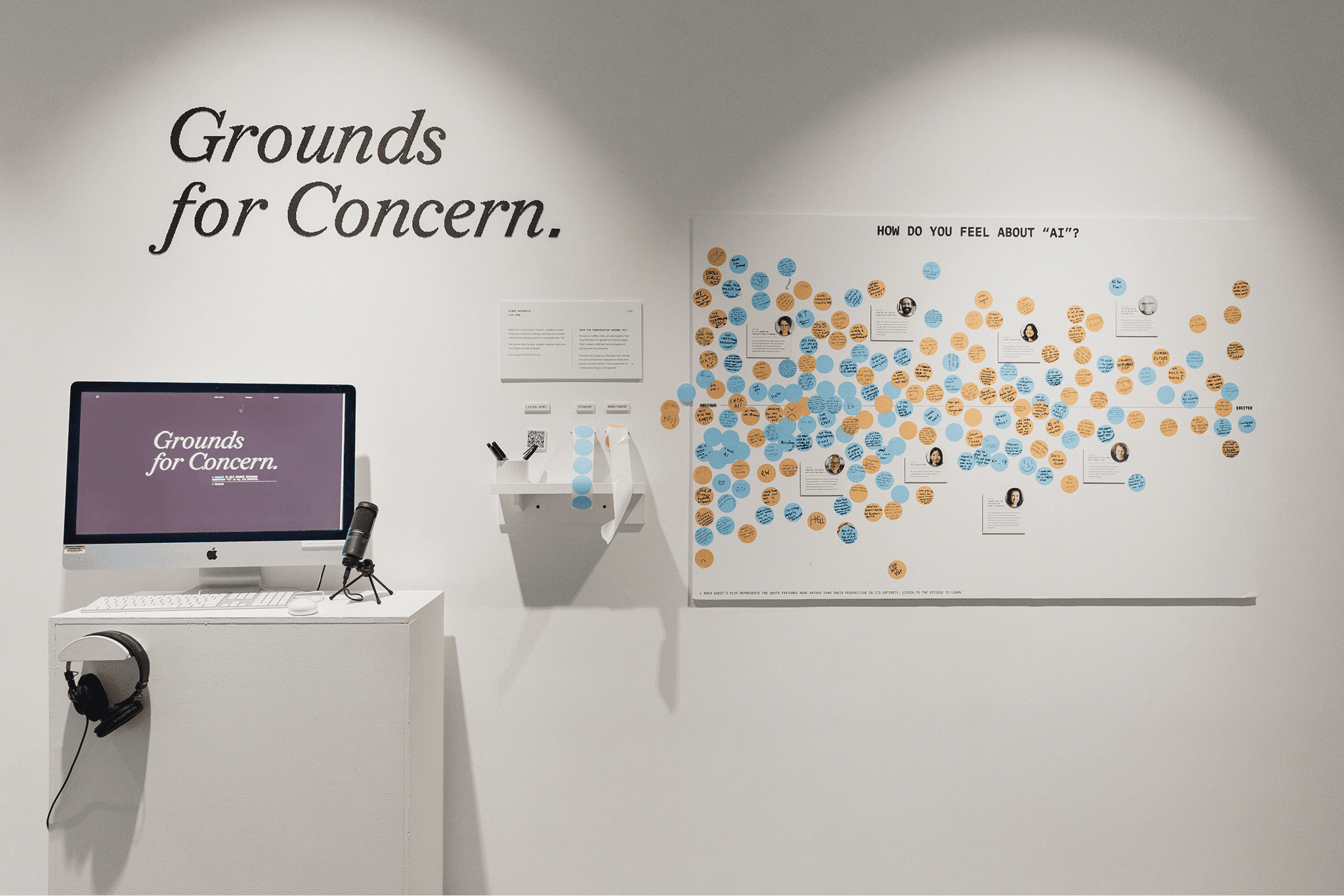
After six conversations with academics, we wanted to know where our own community stood. We crafted an interactive exhibition installation for the UW Design Show 2026, in the Jacob Lawrence Art Gallery. The show ran from June 10-26th, 2026, open to the public.

INTERACTIVE POLLING

How do you feel about “AI"?

How do you feel about “AI"?

How do you feel about “AI"?

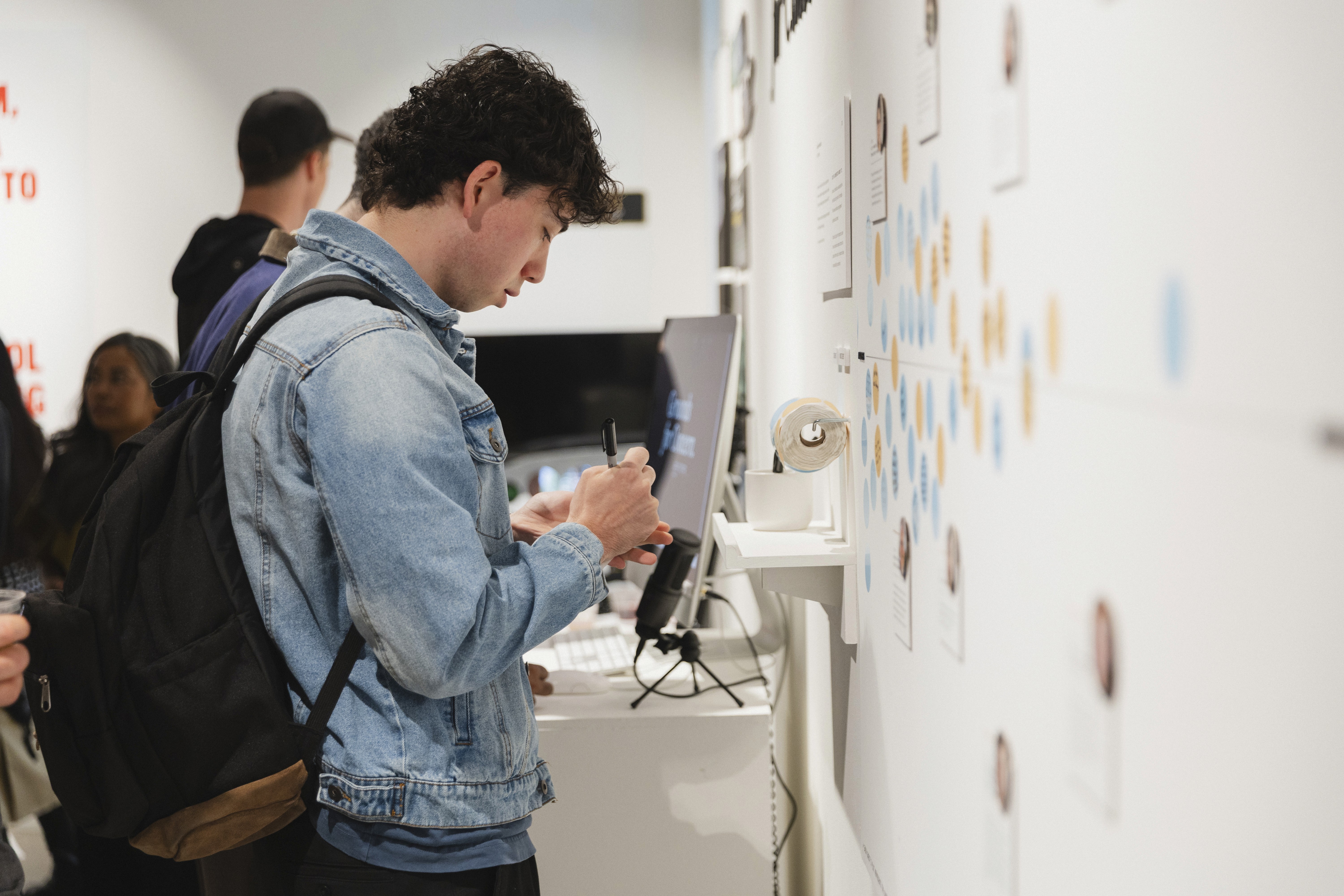
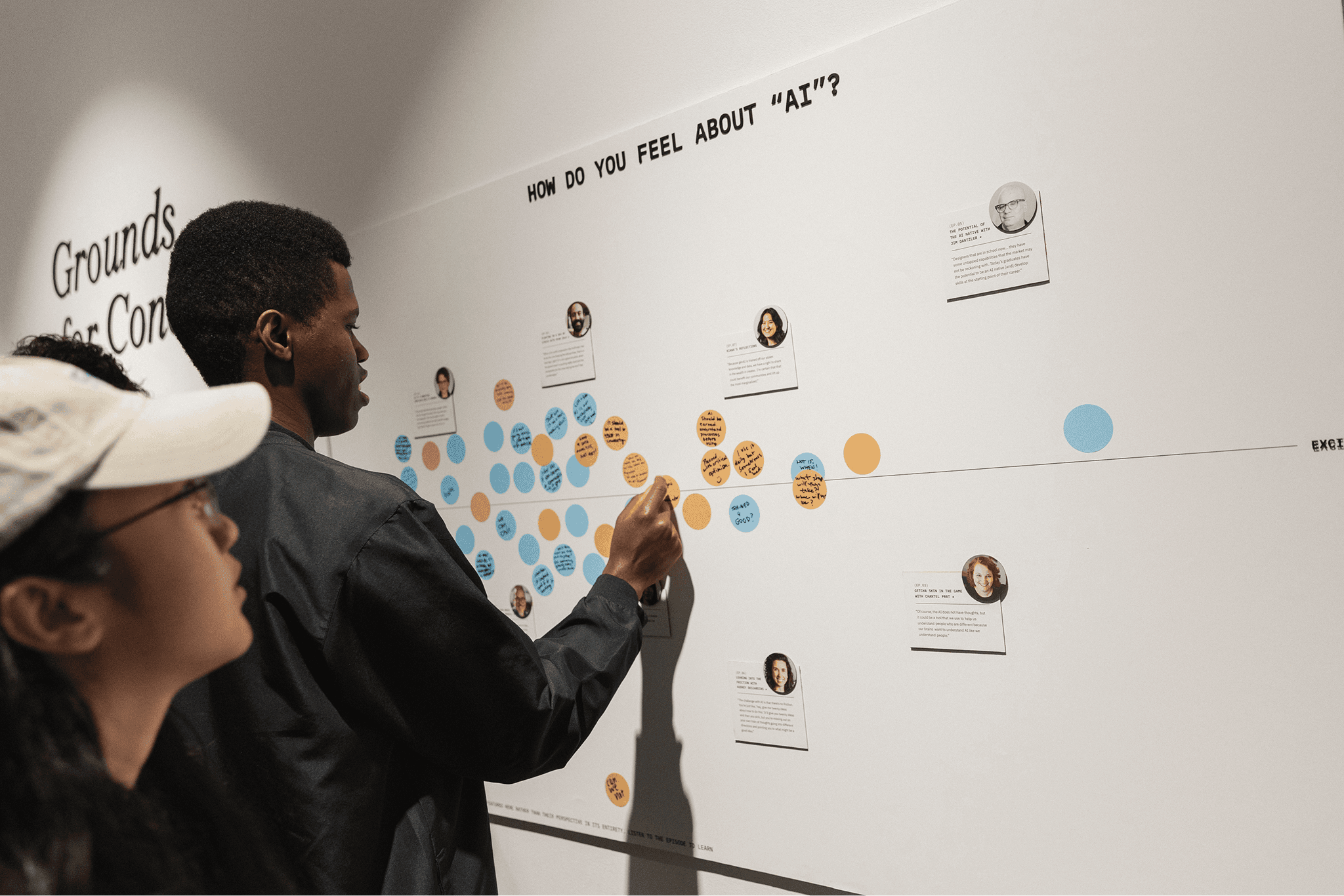
We polled the local Seattle community: on a spectrum from "anxious" to "excited", how do you feel about 'AI'? Participants could leave a note if they wished. This created a growing snapshot of how people were feeling.

Here were some of their thoughts.

Grounds for Delight!

Grounds for Delight!

REFLECTION

This whole project was a true labor of love, and I loved every second of it! And I have many things to say. First and foremost, Lia Chon, my partner in this project, is a true visionary and I could not have done it without her. I am so proud of what we were able to achieve.

Second, podcast hosting is an art in it of itself—a touch of research, a touch of improv, all the while staying an active listener. I have a newfound appreciation for those that dare. So I am incredibly grateful to Chad P. Hall, our mentor and co-conspirator, as well as Ron Krabill, for daring before us.

Third, if you want to continue this conversation, please reach out! I would love to talk further.
kg

© 2026

© 2026

All Rights Reserved

All Rights Reserved